Cambodia’s Taekwondo Community Gathers for Korean Ambassador’s Cup, Embracing a New Era with Virtual Taekwondo
65 participants, including 49 athletes, take part as virtual taekwondo makes its debut
Ambassador Kim Chang-ryong reaffirms Korea’s support for sports cooperation; Deputy Prime Minister Hang Chuon Naron delivers closing remarks
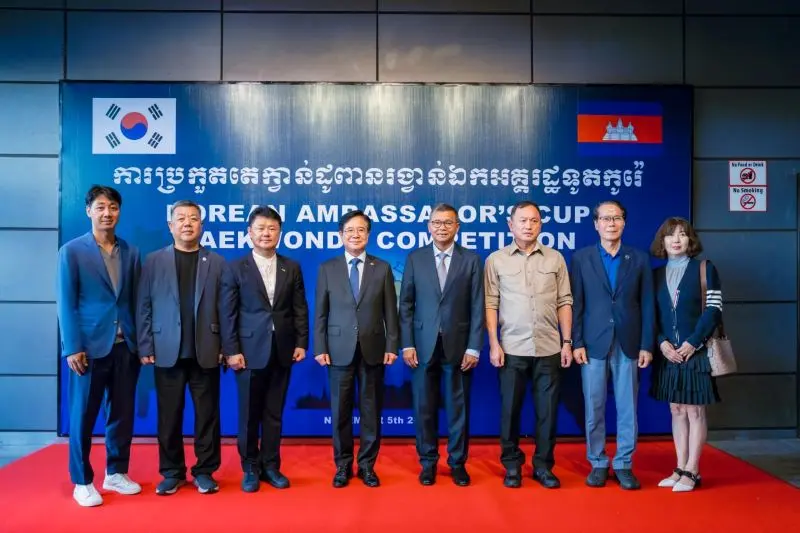
The Korean Ambassador’s Cup Taekwondo Competition 2026 was held on November 5 at the Cambodia-Korea Cooperation Center (CKCC) on the campus of the Royal University of Phnom Penh, bringing together athletes, coaches and officials from Cambodia’s taekwondo community.
The event was attended by Deputy Prime Minister and Minister of Education, Youth and Sport Hang Chuon Naron, who also serves as president of the Cambodia Taekwondo Federation; South Korean Ambassador Kim Chang-ryong; Cambodia Taekwondo Federation Vice President Hwang Soon-jung; Kukkiwon Advisory Member Shin Soo-ah; Korean Association in Cambodia President Chung Myung-kyu; and Vice President Lim Jong-won.
According to the Cambodia Taekwondo Federation, the competition brought together 65 participants, including 49 athletes — 25 men and 24 women — and 16 officials and delegation members. Events included individual competitions for boys and girls under 14, men and women aged 15 to 35, and men over 35, along with a freestyle demonstration event open to participants aged eight and above.
A major highlight of this year’s tournament was the introduction of Virtual Taekwondo, which combines traditional martial arts techniques with digital technology.
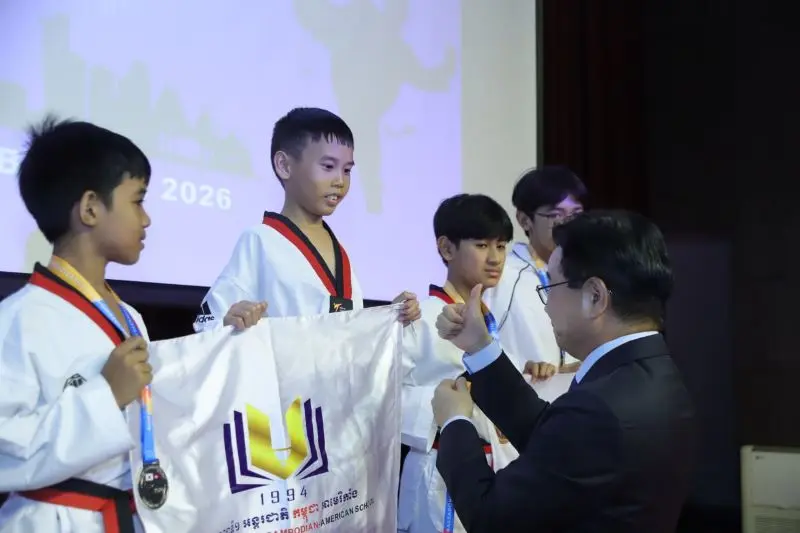
In the girls’ under-14 division, Chan Lucia Lokyan of AAA Club claimed gold after defeating Ty Nanika of FICAS Club. In the boys’ under-14 division, Chea Vorathon of FICAS Club secured first place ahead of fellow club member Ty Sovannreach.
Choub Ponhvorntey of VRTKD Club won the women’s 15–35 division, defeating Heng Mengleab of FCA Club. In the men’s 15–35 division, Seng Mengchhun of Infinity Club took gold with a victory over Chheng Hengly of BT Club.
The men’s over-35 final, held during the closing ceremony, drew particular attention as Chan Frank Shing Kin of AAA Club faced Phon Sophea of BT Club. Spectators cheered as the two competitors exchanged virtual attacks and defensive moves, with Chan Frank Shing Kin securing a 2–0 victory to claim the gold medal.
Four Phnom Penh-based clubs also competed in the team freestyle demonstration event. Hosanna Club finished first with 8.466 points, followed by AAA Club with 8.300 points and Infinity Club with 8.000 points. White Tiger Club placed fourth with 7.133 points.
Virtual Taekwondo uses virtual reality headsets and motion-tracking equipment to translate athletes’ physical movements into a digital competition environment. Instead of making direct physical contact, competitors score through the accuracy and speed of their attacks, aiming to deplete their opponent’s energy gauge.
The discipline has gained international recognition following its inclusion as a medal event at the 2026 Aichi-Nagoya Asian Games. While there is growing interest in its potential Olympic future, Virtual Taekwondo has not yet been included in the Olympic programme.
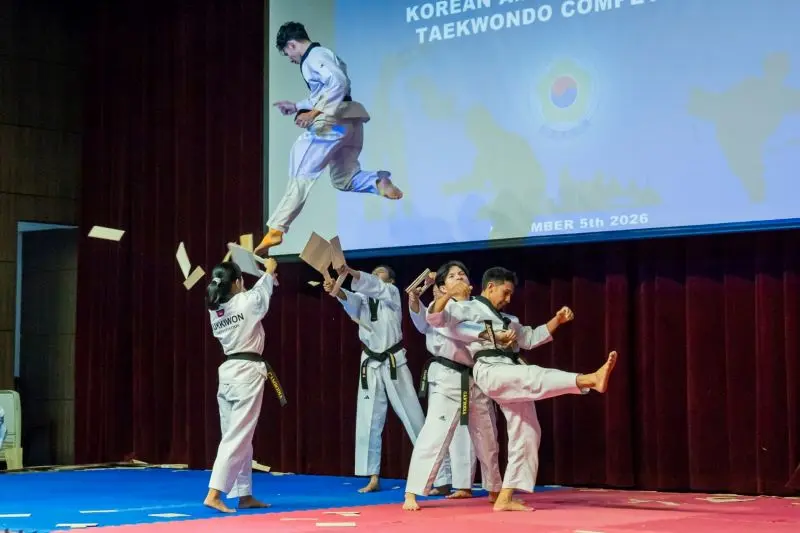
First launched in 2014, the Korean Ambassador’s Cup has become an established platform for developing Cambodian taekwondo talent, identifying promising athletes and strengthening sporting ties between Cambodia and South Korea.
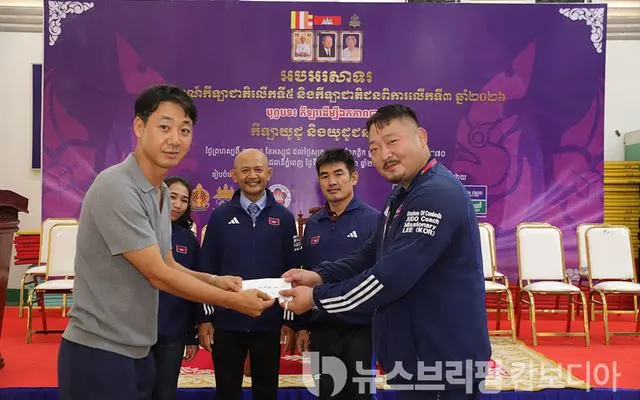
In his remarks, Ambassador Kim Chang-ryong expressed appreciation to Deputy Prime Minister Hang Chuon Naron, officials of the Cambodia Taekwondo Federation and Kukkiwon instructor Choi Yong-seok for their contributions to the sport’s development in Cambodia.
Kim highlighted taekwondo’s evolution from a traditional Korean martial art into a global sport that continues to embrace technological innovation. He also praised the dedication of Cambodian athletes and reaffirmed South Korea’s commitment to supporting taekwondo development and expanding sports and cultural exchanges between the two countries.
Deputy Prime Minister Hang Chuon Naron delivered the closing remarks, congratulating the athletes and acknowledging the efforts of organizers and officials.
This year’s competition not only provided Cambodian athletes with an opportunity to demonstrate their skills but also introduced a new dimension to the sport through digital technology. The debut of Virtual Taekwondo highlighted opportunities to engage athletes across different age groups and support the continued development of taekwondo in Cambodia.